Case study
Rate-Limiter
A lightweight, pluggable rate limiting middleware for Express, built on the sliding-window algorithm.
Free-tier host, first load may take ~30s.
Problem
Express apps need per-client request throttling, but the obvious implementation — a counter that resets every N seconds — has a well-known flaw: a client can fire a full window's worth of requests at 00:09 and another full window at 00:11, doubling the intended rate across a two-second span and hammering whatever sits behind the middleware.
I wanted something I could drop into any Express app with one line, that behaved predictably under that boundary case, and that did not drag a Redis dependency into a project that did not need one.
Key technical decision, and the trade-off
Decision: implement a sliding window backed by an in-memory Map, and define the store as a two-method interface (get / set).
Each key holds the exact timestamps of its recent requests. On every call the limiter prunes anything older than windowMs, then either records the new timestamp or rejects:
const cutoff = now - windowMs;
const timestamps = (buckets.get(key) ?? []).filter((t) => t > cutoff);

if (timestamps.length >= maxRequests) {
  const retryAfterMs = timestamps[0] + windowMs - now;
  return reject(retryAfterMs); // oldest request decides when capacity returns
}

timestamps.push(now);
Why not fixed window: it is simpler and cheaper, but it permits the boundary burst described above. For a portfolio API guarding an endpoint that calls an external service, that burst is exactly the failure mode worth avoiding.
Why not token bucket: buckets smooth bursty traffic well, but they also allow a legitimate burst up to the bucket size, which makes the limit harder to explain to a client reading X-RateLimit-Remaining. Sliding window gives an exact, honest number.
The trade-off, stated plainly: sliding window stores n timestamps per key instead of one integer. Memory per active key grows with maxRequests — so it is O(limit) per client rather than O(1). For a per-IP limiter with a limit in the tens, that is a few hundred bytes per active client and entirely acceptable. For a limit of 10,000 requests per window it would not be, and a counter-based algorithm would be the right call.
The other trade-off is process locality: an in-memory Map is per-instance. Behind multiple Node processes the effective limit multiplies by the number of instances. That is why store is an injectable interface — swapping in Redis is a one-object change and does not touch the middleware:
const redisStore = {
  get: (key) => redis.get(key).then((v) => (v ? JSON.parse(v) : undefined)),
  set: (key, value) => redis.set(key, JSON.stringify(value)),
};
Architecture
Express app
incoming request
rateLimiter(opts)
middleware, one line
Sliding window
prune → count → decide
Result
Held a steady 5 req/10s under a 200 req/s k6 load test
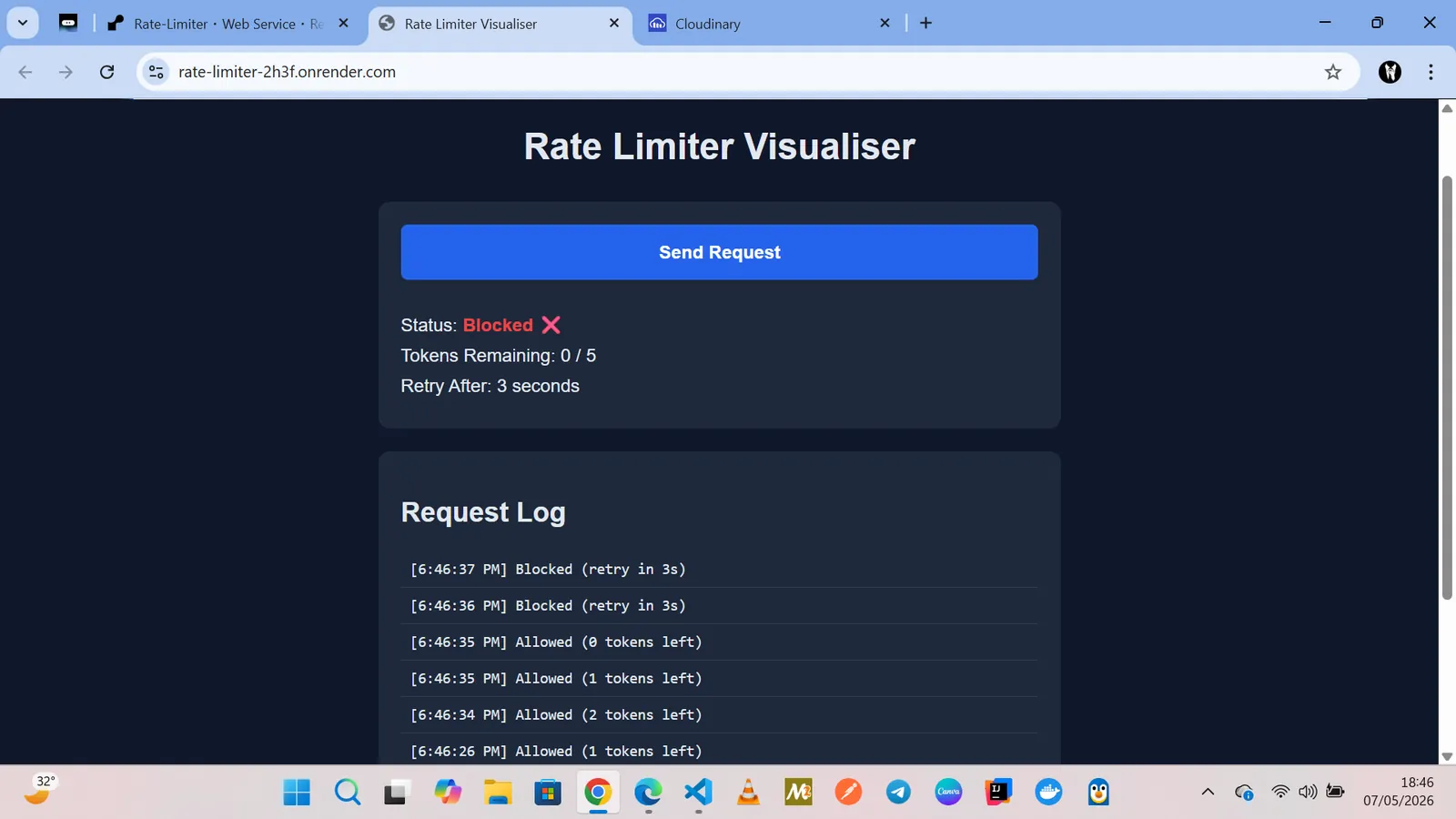
The demo visualiser shows the sliding window moving in real time against incoming requests, which is the clearest way to see the pruning behaviour:
What I'd do next
- Publish to npm — the package currently has to be cloned, which is the biggest barrier to anyone actually using it.
- Add the token-bucket and fixed-window algorithms behind the same config surface, so the trade-offs above become a one-line choice.
- Ship a Redis store in-repo, plus a test suite that pins the boundary behaviour (the burst case at 00:09/00:11) as a regression test.
- Add
X-RateLimit-Resetin both seconds and milliseconds with a documented convention — the current ms-only value trips people up.