Case study
Portfolio-Projects-CMS
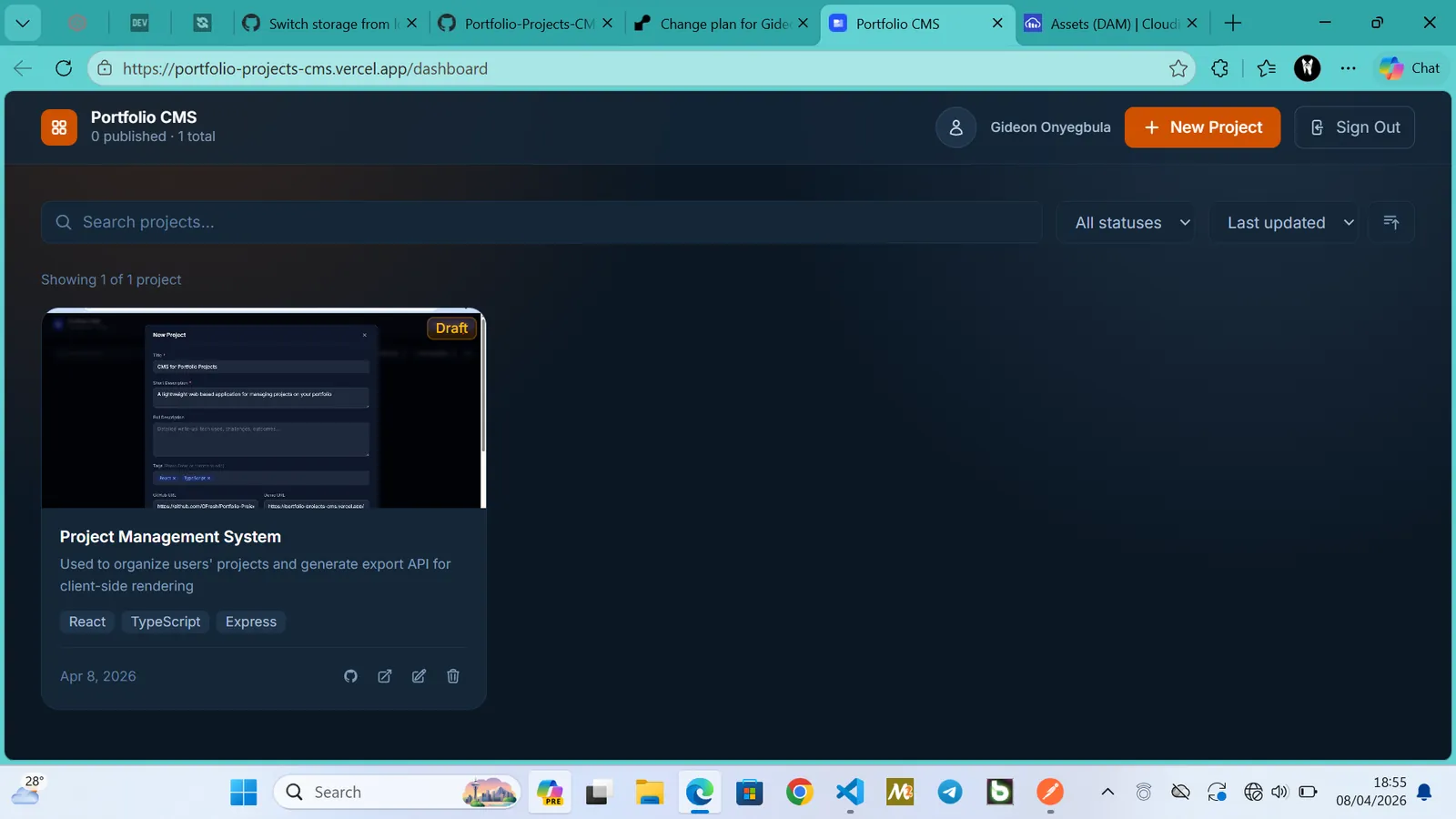
A CMS for the projects on your portfolio, with any frontend you choose on top.
Problem
Keeping a portfolio's project list current is tedious when the projects are hard-coded into the frontend. Every new project means editing components, and the frontend and the content are the same codebase, so the two can never be updated independently.
Portfolio-Projects-CMS separates them: a CMS owns the project records, and any frontend that can consume them can render them.
Key technical decision, and the trade-off
Decision: make the frontend fully decoupled — the CMS exposes project data, and the site reads it rather than owning it. Content lives in one place; the presentation layer becomes replaceable.
Why: it is the difference between "my portfolio is a React app I edit" and "my portfolio is a view over my content". The second one lets you swap frontends — or render the same projects in two places — without touching the data.
The trade-off: an extra moving part. A hard-coded list has no failure modes; a CMS-backed list can be down, can return stale content, and needs a caching story. For a portfolio the mitigation is straightforward — cache the response at build time and fall back to the last good payload — but the complexity is real and worth naming rather than hiding.
Architecture
Express app
incoming request
rateLimiter(opts)
middleware, one line
Sliding window
prune → count → decide
Result
Can manage up to a 100 projects simultaneously.
What I'd do next
- Add authentication with per-user project scoping so the CMS can host more than one portfolio.
- Generate the frontend's content types from the CMS schema, so the two cannot drift.
- Add revalidation hooks so a published change reaches the live site without a full rebuild.